

County Bridewell and Town Gaol, Devizes, Wiltshire
A Wiltshire County Bridewell, or House of Correction, was established in 1579 on what becme known as Bridewell Street, Devizes. It was also used as the Devizes Town Gaol. The building, originally a timber-framed structure, was burnt down in 1619 and again in 1630, but rebuilt on each occasion, still with a wooden frame. The building was re-fronted in brick in 1771, the date recorded in studs on the original front door which was reused.
In 1784, John Howard wrote:
This is also the Town Gaol. It has two night rooms for men, and two for women: but the day-room and court-yard with water, common. — A small work-shop; I saw no body in it.—An Infirmary of two rooms.—Four rooms for Master's-side Debtors.—All clean at my last visit; lately white-washed &c.
Allowance to Offenders three-halfpennyworth of bread a day (weight in Sep. 1776, 18 ounces), and a pint of small beer. Straw a guinea a year.
There was a Debtor from the Court of Requests, he had a wife and four small children. Twelve weeks confinement clears fuch Debtors.
Two or three years ago the Gaol-Fever carried off many: but as the Infirmary and some of the other rooms mentioned above have been built since that time, there is now little danger of that distemper; provided care be taken to separate Prisoners in the apartments built for that purpose. Clauses of Act against Spirituous Liquors not hung up.
The Gaoler has a Salary of £10, and keeps a public-house.
| Debtors. | Petty Offenders. | ||
| 1774, Aug. 4 | 3 | 17 | |
| 1776, Sep. 4 | 1 | 13 |
In the mid-1780s, the prison was rebuilt on the same site. In 1791, Howard reported:
A new prison with six separate courts, of which one only can be viewed by the keeper from his windows. The magistrates have improperly built on the old close and confined spot; a fault too common in such cases, when at no greater expense, a more healthy situation might have been chosen, out of the town. Employment, said to be making nets. Surgeon's salary now £15. No chaplain. Allowance to felons now three-pence a day in bread, a pint of small beer, and two pound of potatoes a week. Gaoler's salary £100.
1788, May 29, Debtor 1. Felons and Petty Offenders 29.
A prisoner, Thomas Platt, lately died in one of the solitary cells, and the verdict of the coroner's jury was, died by hunger and cold. Since this, the allowance was augmented as above.
In 1812, James Neild wrote:
Gaoler, Joseph Draper. Salary , 100l. Fees, none .
Chaplain , Rev. Mr. Leddiard . Salary , 20l. Duty , every Sunday.
Surgeon, Mr. Gibbs. Salary, 15l.
Number of Prisoners,
| Debtors. | Felons &c. | Lunatic. | ||
| 1801, Dec. 15th | 2 | 41 | 1 | |
| 1804, July 27th | 0 | 29 | ||
| 1806, Oct. 15th | 2 | 22 |
Allowance, to Debtors, none; unless certificated as Paupers. To Felons, &c. one pound twelve ounces of best wheaten bread, in loaves to that amount from the Baker's, and which I have always found of full weight.
The Debtors sent to this Prison are committed by the Court of Requests for the adjacent Hundreds of Bradford, Melksham, and Whorlsdown. The expence attending their commitment sometimes becomes highly aggravated; frequently it exceeds the original debt, and is such as almost to preclude the possibility of a compromise.
One of the commitments, which I copied in 1801, was as follows: Debt, 10s. 6d. Costs, 1s. 9d. additional Costs, 11d. Further Costs, if the Defendant is carried to Prison, are 10s. 6d. Now, as Debtors of this description are never enabled to pay the original debt, and costs, and charges, they must suffer confinement for 20 or 40 days, as prescribed by the Act;-to the injury of health, or the destruction of morals, or both.
They are not here, as in many County Gaols, confined amongst other Debtors; they ought not therefore to be sent to Bridewells; but, so long as this system of Imprisonment for Driblets of Debt, is cruelly permitted, they should be sent either to the County Gaols, or to one purposely built, with an allowance of proper society, food, and bedding. But here, there is no separate ward, nor a court-yard for Debtors; who therefore must associate (if at all) with Felons, and other criminal Offenders.
At my visit in October 1806, several, in the Women's ward, appeared to be of the most lewd, profligate, and abandoned sort: yet, confined to such association, I found a poor hard-working Woman-Debtor, and a Man who had been committed hither from the Court of Requests, both living in common with the Criminals.
In this Prison are six court-yards. The principal, or Felons', is 38 feet by 30: Their day-room, 18 feet by 17, and 7 feet high, lighted by one iron-grated window. Over this their sleeping-room, of the same size, 7 feet 6 inches high, with a chimney and ventilator; and good beds and bedding are furnished by the Keeper, at 2s. and 1s. 6d. each per week.
On a level with the Felons' day-room is a work-room, 26 feet by 14, and 7 feet high, with three iron-grated windows: The floor is excavated, and contains two hemp-blocks. Over this is their night-room, of equal size, 6 feet 9 inches high; supplied also with three iron-grated windows, inside shutters, and two ventilators, and containing fourteen beds.
From this court-yard you enter into a lobby, 21 feet by 10, and 9 feet 6 inches high; leading to twelve cells, six on each side of a passage five feet wide. The cells are 10 feet by 7; lighted by an iron-grated window, and each fitted up with two ventilators, a crib bedstead, straw-in-canvas bed, and one blanket. These cells are encircled by a narrow court-yard.
Adjoining the Women-Felon's ward is a court-yard, of 50 feet by 20, with a dayroom, 21 feet by 16 feet 9 inches, and 7 feet 2 inches high. In this ward were nine Women and two Children confined. Above it is their sleeping-room, of the same size, with two iron-grated windows, five beds, and a chimney-piece.
The Infirmary, 22 feet 6 inches by 16 feet, and 7 feet 4 inches high, consists of two rooms above each other; the higher one, with a boarded floor, appropriated to the Women, the other stone-floored, assigned for the Men: They have each a fire-place, with two iron-grated glazed windows, and are well-ventilated. In the Men's Infirmary was one poor Lunatick. The Infirmary court-yard is 23 feet by 27, The court-yard belonging to those committed for misdemeanors is 38 feet by 32, and has two hemp blocks, placed under the arcades. Their day-room, 38 feet by 16, is 7 feet 6 inches high: sleeping-room, 25 feet by 16, and of the same height as the former; each having three iron-grated windows, and two ventilators. The Chapel is small and neat. The Women have a separate gallery to themselves, opposite the pulpit.
There is a day-room in every court-yard, with a fire-place in each; but no fuel allowed. The sleeping-cells are well-ventilated, and fitted up with a wooden bedstead, straw-in-sacking case, and a blanket each, for every Prisoner, all laid on the boarded floors.
Notwithstanding the work-rooms and hemp-blocks above enumerated, decipimur specie recti: Appearance is the order of the place. There is seldom any employment in this County Prison of Wiltshire: and yet, the Keeper told me, that he had had, at one time, sixty-four Prisoners under his care. If they can procure work, they receive half of their earnings; and the County has the other half, deducting only one penny in every shilling, which is allotted to the Keeper for his trouble.
The Corporation provides no bedding for Debtors, nor is there any fuel allowed, even in winter.
Of the six court-yards, that only which is for the Felons can be viewed by the Keeper from his windows; the area of one of them is nearly occupied by sleeping-cells. Each court-yard has a sewer, and water.
The Prison is white-washed once a year. Here is a bath of stone, with a boiler for supplying water warm and cold. An oven also is provided, for purifying the Prisoners' clothes; but, according to the Keeper's account, it has never been used.
No Rules and Orders. The Act for preserving the Health of Prisoners is printed, not hung up; but the Clauses against their use of Spirituous Liquors are properly exhibited.
A palisaded fence was wanted before the back door of the Keeper's house. If a latticed partition and door were made in the Criminals' court, about six feet from the Keeper's door, it would prevent Prisoners from rushing out, of which, as he told me, he was sometimes apprehensive.
This ill-constructed Prison, however, is expected to be soon taken down; and as a new one is building, in a better situation, a more ample description of every particular is needless.
In 1810, construction began on a new Wiltshire County Gaol at the west of the town. After the still incomplete building opened its doors in 1817, the old bridewell was mostly used to house pre-trial suspects. It ceased use as a prison in 1836 and was converted for use as a county police station.
In 1879, the police station moved to new premises and the old bridewell was sold. In 1891, the building was in use as a 'Ladies' School'. The property then became a home for needy old women of the town. In 1979, the Devizes Almshouse Trust converted it into self-contained flats for modern-day almswomen. Now known as The Grange, a reminder of the building's origins can still be seen in the graffiti on the walls of the exercise yard, now a garden, and in its the attics.
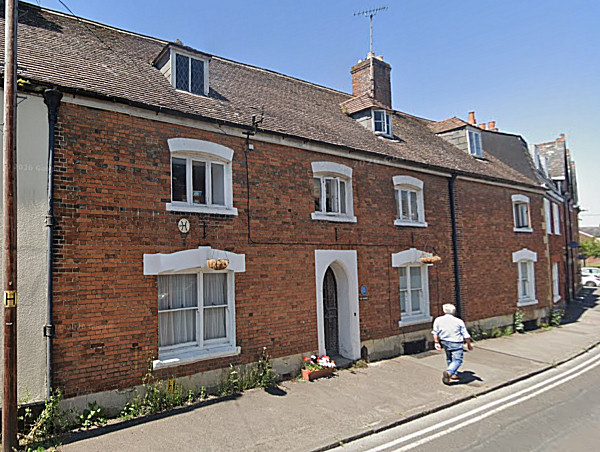
Former County Bridewell and Town Gaol, Devizes. &;copy; Google
Records
Note: many repositories impose a closure period of up to 100 years for records identifying individuals. Before travelling a long distance, always check that the records you want to consult will be available.
- Wiltshire and Swindon Archives, Wiltshire and Swindon History Centre, Cocklebury Road, Chippenham SN15 3QN. Jut a few administrative items survive.
- The National Archives, Kew, Richmond, Surrey, TW9 4DU. Has a wide variety of crime and prison records going back to the 1770s, including calendars of prisoners, prison registers and criminal registers.
- Find My Past has digitized many of the National Archives' prison records, including prisoner-of-war records, plus a variety of local records including Manchester, York and Plymouth. More information.
- Prison-related records on
Ancestry UK
include Prison Commission Records, 1770-1951
, and local records from London, Swansea, Gloucesterhire and West Yorkshire. More information.
- The Genealogist also has a number of National Archives' prison records. More information.
Bibliography
- Higginbotham, Peter The Prison Cookbook: A History of the English Prison and its Food (2010, The History Press)
- Brodie, A. Behind Bars - The Hidden Architecture of England's Prisons (2000, English Heritage)
- Brodie, A., Croom, J. & Davies, J.O. English Prisons: An Architectural History (2002, English Heritage)
- Harding, C., Hines, B., Ireland, R., Rawlings, P. Imprisonment in England and Wales (1985, Croom Helm)
- McConville, Sean A History of English Prison Administration: Volume I 1750-1877 (1981, Routledge & Kegan Paul)
- Morris, N. and Rothman, D.G. (eds.) The Oxfod History of the Prison (1997, OUP)
- Pugh R.B. Imprisonment in Medieval England (1968, CUP)
Links
- Prison Oracle - resources those involved in present-day UK prisons.
- GOV.UK - UK Government's information on sentencing, probation and support for families.
Except where indicated, this page () © Peter Higginbotham. Contents may not be reproduced without permission.