


County Gaol and House of Correction, Devizes, Wiltshire
In 1808, Richard Ingleman, the architect of the prisons at Folkingham in Lincolnshire and Southwell in Nottinghamshire, presented Wiltshire's gaol committee with his proposed design for new county gaol and Bridewell, or House of Correction, to be built at Devizes. It was located in an airy situation on the Bath Road, near what became known as Prison Bridge, and construction work began in 1810. Though still incomplete, the new prison opened its doors in 1817. By 1821, there was accommodation for 130 inmates, with foundations in place for buildings to hold another fifty. The final cost prison cost of the scheme, including land, was £40,207 19s 7d.
The prison was designed on the panopticon principle consisted of a circular central administrative and supervisory building surrounded by a sixteen-sided outer building, with a walled yard lying between the centre and each of the sixteen outer segments, as illustrated below.
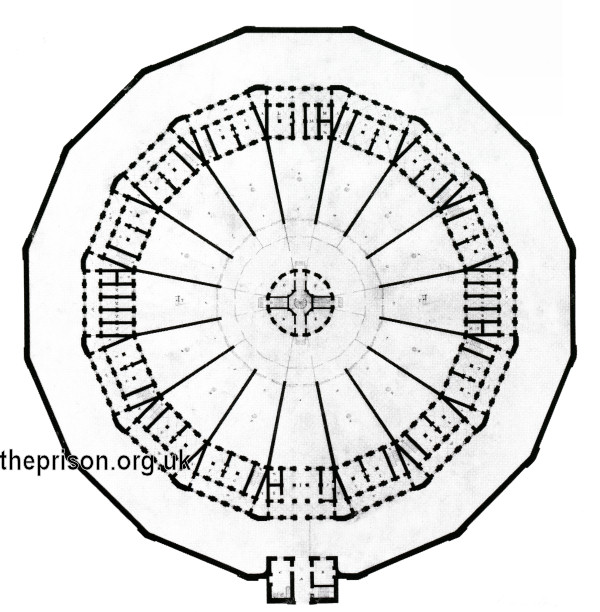
County Gaol, Devizes, Wiltshire, c.1808.
The central building contained offices and accommodation for the governor and taskmaster, and two infirmaries in its attics. Of the planned sixteen outer blocks, only ten were initially built, with an eleventh been added by 1867. A continuous corridor ran around the ground floor of the prison. At its inner side, work cells, dayrooms, sleeping cells, stores and various service rooms occupied the ground floor. The first floor contained further sleeping cells, while the blocks forming the four cardinal points of the design were left as tall open arcades. Thses provided for the free circulation of air and a place for prisoners to exercise in bad weather.
In 1821, it was reported:
The Governor resides in the centre; and from his windows he inspects the yards, which are enclosed by a circular range of building appropriated for the prisoners, at present extending only two-thirds of the circle, but which may at any future time be completed if wanted. This circular building contains 104 solitary night-cells; about forty solitary working-cells, for the use of the first class of prisoners, viz. felons; and also several good day rooms, which are in use by the remaining class, viz. misdemeanants, who work in companies. The passages to these rooms on the lower story being very spacious, are occasionally made use of: when visited, one of these was furnished with benches and a long desk, in which the younger prisoners are collected at school in the evening
The discipline to which the prisoners are here subjected is uncommonly strict. The confinement of the first class, viz. the felons, during the former part (which in some instances has extended to twelve months) of their term of imprisonment, is in almost constant solitude. Each felon quits his separate night cell in the morning, to be locked up for the day in his solitary working-cell: here silence is strictly enforced; and, excepting an occasional visit from the Governor or Chaplain during the day, his only regular visitors are the taskmaster, who watches over his work, and the turnkey, who brings him his food, and unlocks him for half an hour only in the day, to take exercise in the yard; but he is still in solitude and in silence.
On their being first received into prison, they are informed, that if, during the first half of their term of imprisonment, they conduct themselves in an orderly and industrious manner, they will then be allowed to take exercise on Sundays in the yards of their respective wards, and be permitted to associate with those of the same class to whom such privilege may also have been granted. On the contrary, solitary 'confinement for the whole term of their commitment (with the exception of half an hour per day for exercise) will be awarded to those who in any way have been guilty of a breach of the rules of the prison. Some of the prisoners in their working cells, were knitting their own stockings, others making shoes, gloves, straw hats, or weaving shirting, blanketing, and cloth, for the prison service.
In each of the cells is placed a Testament, a Prayer-book, Crossman's Introduction to the Christian Religion, and occasiónally a sermon; and the Chaplain frequently visits and converses with the prisoners.
The prisoners are not allowed any share of their earnings, but when the period of their imprisonment is concluded, money is given to them as a gratuity, to enable them to proceed to their homes.
In 1823, a tread-mill was installed at the prison. By 1826, a new mill-house had been built outside the boundary wall, the machinery of which was connected by a shaft with the tread-wheels, so as to be kept in motion by the prisoners' labour. The prisoners were employed at grinding corn by the tread-wheel, and by a crank-handle mill, and in working a machine to raise water for the supply of the prison. The dietary consisted of 1¾lb. of wheaten bread daily, one pint of oatmeal gruel, with salt, for breakfast, and one pound of potatoes for dinner; but twice a week a pint of vegetable soup is substituted for the potatoes.
| The number of criminals committed in the year ending the | |
| 1st January 1817 was 207 |
These consisted of |
| Ditto . . . 1818 . . . 496 | |
| Ditto . . . 1819 . . . 482 | |
| Ditto . . . 1820 . . . 439 | |
| Ditto . . . 1821 . . . 504. | |
| seven have been committed under second warrants, four only of which number are for felony," giving a ratio of 3.6 per cent. on the general aggregate, and the fraction of 0.8 per cent. on the felons! | |
Of the above 473 prisoners for felony, four only, during a period of more than five years, have been re-committed for the same offence. The Governor states, that from Hilary to Easter Sessions this year, eleven have returned to him who were in the prison before.
The second class contains the several descriptions of misdemeanants,and such of the first class whose term of solitary confinement, from good conduct, has been abridged by order of the Magistrates. These are employed at various kinds of work for the service of the prison, such as turning reels for the looms, clog making, also wooden soles for the prisoners' shoes, tailoring, spinning, &c.; these prisoners have rather a better ration of food; they also work at the corn mill, which is on the capstan plan, and requires sixteen men to work it at a time. The number of women is small in this prison; their employment is washing, making up and mending the prison clothing, which generally affords them full occupation. The average cost of food is from 2s. 4d. to 2s. 6d. per week each; the ration for the first class is 1¾ lb. of bread made in the prison, and 1lb. of potatoes; the second class has half a pound more of potatoes. The bedsteads are of iron, and the bedding is good. The cells are in admirable order; every where much cleanliness appeared.
In 1837, the Inspectors of Prisons reported:
HOUSE OF CORRECTION.
Construction.
There is a good inspection from the governor's house over all the yards. The building appears secure; it has two outer walls, and is not overlooked by any other edifice. There are eleven wards, and eleven yards: ten of these belong to the men, and one to the females.
| Total number of cells of all kinds | 210 |
| Of these are single sleeping cells | 207 |
| ditto ditto for males | 187 |
| ditto ditto for females | 20 |
| Of these are cells where more than one sleeps | 3 |
| ditto ditto male sleeps | 3 |
| ditto ditto female sleeps | 0 |
The dimensions of the single cells for the men are, 10 feet high, 7 feet 3 inches wide, and 8 feet 3 inches long; that of the women, 7 feet high, 5 feet wide, and 7 feet 5 inches long.
It will be perceived that the male cells have a considerable advantage above the female ones in height and extent. The female cells, indeed, form the chief blemish of the gaol. They are placed just opposite to each other on each side of a narrow passage: over each door is a large aperture, through which the inmates can converse together most commodiously. The matron is the wife of the governor; and there is no one sleeping at hand to superintend them at night. The women use a day-room common to all. All the female cells are too small, are principally made of wood, and very ill ventilated; the western cells, indeed, have no windows that open, and are damp from the gutter which passes close to the roof.
The cells are heated by introducing warns air into the corridors.
Management.
The turnkeys, miller and porter are all chosen and appointed by the governor, out the salary of each is fixed at the quarter sessions. The present governor has been here 14 years. He has the power of ordering broken windows to be repaired, without consulting a visiting magistrate, a privilege which does not exist in ail prisons. The head turnkey has the principal charge of the registers. or acts the part of clerk.
There are no untried prisoners here, and no debtors. All the prisoners, of both sexes, have each a separate cell: the same cell is used by day and by night. A certain number are locked up in their cells the whole clay, excepting during the period of exercise: the details of this arrangement will be found under the head of labour. Silence is enjoined.
Any magistrate may give an order for a visit; and there is no limit to the number of visitors. except that caution is recommended. An officer is always present during the visit, which may be half an hour in length, but is usually shorter.
No slates nor writing arc commonly permitted.
Monitors, or wardsmen, are chosen from among the prisoners: they keep the wards clean, and may report misconduct. They arc not liked by the other prisoners, and enjoy no other privilege than exemption front labour.
The punishments for prison offences are—confinement in a day-cell; privation of their covering. but not of their bedding; or reduction to bread and water diet.
There is a want of specially constructed dark cells: no such were made originally, but half a dozen can be fitted up for the purpose by shutters; the stay in them is not more than three days.
In flogging, seldom so many as 40 lashes are inflicted; 28 is the average, with a cat-o'-nine-tails of whipcord; the surgeon is not present, nor are the prisoners: when for a prison offence. then it was inflicted in presence of the prisoners; this has not happened for many years.
During 14 years not one attempt at suicide has been known, nor any alarm from fire. Two prisoners have contrived to escape, but both were retaken.
Salaries.
| Governor | per annum | £50 |
| Matron | ditto | 30 |
| Sub-governor | ditto | 60 |
| Turnkey and miller | ditto | 46 |
| Three turnkeys, at £42 each | 126 | |
| One porter | per annum | 25 |
| Chaplain | ditto | 150 |
| Surgeon | ditto | 80 |
The surgeon finds medicines at his own cost, but he is allowed to charge for trusses. No officer of the gaol has any allowance or perquisite whatever.
Account-Books, Registers, &c.
are the magistrates', chaplain's, surgeon's, governor's, commitment-books, account-book, description-book, book for casual visitors and strangers, punishment-book, miller's book, stationery-book, grocery-book, bricklayer's, carpenter's, plumber's, and a few other tradesmen's books.
Diet.
Two pounds of wheaten bread, one pint of gruel made from one ounce of oatmeal, and one pound oaf potatoes, are allowed daily. On Wednesdays and Fridays, in lieu of potatoes, one pint of vegetable soup, made according to discretion of the governor, with a few peas and other vegetables. To those who work on the tread-wheel, when the hours of labour exceed eight per day, one biscuit each of the weight of four ounces: salt as wanted. Warm water is not allowed, but the gruel is given warm in the morning. Meals are taken in the cells at half-past eight, and at one. The biscuit is given on the wheel in the afternoon. No contract for corn: an agent purchases it. The governor buys the potatoes,at the best season.
Every prisoner receives for clothing one jacket, one waistcoat, a pair of trousers, a pair of stockings, a pair of shoes, one shirt, a stock, and a cap.
Every prisoner has for bedding a straw mattress, one sheet, one rug, two blankets in winter, and in summer only one, and a night-cap.
Labour.
There is a tread-mill here which grinds corn for the prison and for the public. There is. also a crank for raising water which employs two persons who may happen to be incapacitated for the tread-mill by some infirmity. Another crank-mill, capable of employing 16 men, is now disused, on account of the difficulty of maintaining good order at it. The other occupations are whitewashing, baking (under the guidance of a miller), cooking, cleaning. The females wash for the whole prison, and mend - for all, but they make no clothes worthy of mention: they make up a few shirts, and all the beds and sheets. At the time of my visit eight women were engaged in washing; two prisoners were employed in the bakehouse, two in the kitchen, six or eight at the crank, and 60 at the tread-mill. There are eleven wardsmen, and one tailor is at his work. About 100 prisoners out of the whole 126 are now at work. Those who do not work at hard labour owing to infirmities, as well as those just entered, (who for the first ten days remain in their cells,) take only half an hour's exercise twice in the day. They go out to wash for a few minutes in the morning, and are also let out by the wardsman (on knocking) for their natural wants throughout the day. Only one takes exercise in the yard at the same time.
Two prisoners are often employed in cultivating the land around the prison under the guidance of an officer. It has been stated to me that prisoners are employed occasionally in a field near the gaol appropriated to the governor's use, and that they also,occasionally tend his cows. Whether this is true or-not—and I trust that,,if it has happened, it will not occur again—it is a violation of good discipline to employ prisoners on any pretext outside of the walls of a prison. Once outside, they can be familiarly seen by others, and ran see others in turn: it is a return to comparative liberty for the moment, and restores that communication with the external world which it is one of the objects of a prison to cut off.
The hours of labour are, during the summer, 94 hours; during the rest of the year the hours vary, but they never fall short of 61 hours.
The profits of the labour in money are about £30. All the profits of labour are appropriated to the county.
Religious and other Instruction.
The chaplain has been in office since the year 1822, and assisted the chaplain the two preceding years. He reads prayers daily and performs morning and evening service on Sundays, with one sermon. At the time of my visit there were no compartments or divisions in the chapel: it is highly desirable that they should be supplied, as many in number as there are wards, although the governor believes he can command attention by his glance. So far front divisions being unnecessary in the chapel of even the best regulated prison, I am of opinion that it would form a material improvement if every prisoner could be insulated from his fellows, so as to preclude the possibility of either present or future recognition; but such a measure could neither be easily nor economically accomplished. The chaplain orders such books as he thinks proper for the use of the prisoners, and the bookseller sends his bill in at the sessions. The chaplain keeps both a public and private journal; in the latter he takes a note of the birth, education, and character of those intrusted to his spiritual charge: he visits every prisoner in his cell on his first admission, and converses readily with them. He forms the prisoners into classes of from 15 to 18 in general; the lowest number composing these classes is 12, and the highest is 24: he assembles one of these classes every day after the service. If he finds that they already know their letters, he assists them in reading, and has thus taught many to read; but he does not usually teach the A B C. There was once a schoolmaster for the prisoners, but he has been dismissed. The chaplain has never been requested by any prisoner to administer the sacrament; they have never alluded to the subject. He has never made an offer to do so, because lie does not possess sufficient means of ascertaining that the repentance is sincere. It is remarkable that, in the many cases in which lie has interrogated the prisoners as to whether they have ever received the sacrament, he has never known any instance in which they have replied in the affirmative. This is a forcible proof, if any new one were wanting, how rarely the inmates of a gaol have been imbued with religious principles; and it well illustrates the important distinction between an education merely literary, and that deeper instruction which combines Christian with worldly knowledge. The chaplain has favoured me with his experience upon the subject of re-committals. He observes that those who have been flogged often return: according to him the flogging is usually deferred to the last period, instead of being inflicted at first: the culprit consequently leaves the poison degraded in his own estimation, angry, excited, hating all, and ripe for future mischief. Those who have been placed in the infirmary often return to the prison; he believes it to be a fruitful source of corruption, and expresses an opinion, in which I heartily concur, that the infirmary should be attended by a wardsman who is not a prisoner. There is no instruction whatever for the female prisoners. The chaplain applied to the magistrates to give permission that some ladies in the neighbourhood might act as teachers, to the:females, but this was declined. The women rarely ask to see the chaplain; but when one of them happens to be ill he generally .goes to see them. It is his uniform custom to visit every prisoner who requests to see him. He is friendly to short imprisonment, with confinement to the cell, without labour, for 20 days.
Care of the Sick, Disease, and Mortality.
There is an infirmary for the men, containing two rooms one of these rooms is usually devoted to the use of the sick, and the other is set apart for the convalescent. There is also a separate infirmary for the females. The surgeon does not note down every case in which a medicine is given, but. only those which are placed in the infirmary, or those in which some extraordinary indulgence, or relaxation of discipline, is granted. Every prisoner on his admission is examined by the surgeon, has a warm bath, and is then reported by the surgeon as fit or unfit for hard labour. In cases of varicose veins, hernia, enlargement of the joints, and other injuries, the tread-mill is forbidden; but the surgeon has never known a ruptured mats to suffer from working at the crank. Venereal diseases and itch are frequent. When a prisoner comes in with itch he is retained in the reception-cell for three days; during that time the compound sulphur ointment is rubbed in three times, in the quantity of a quarter of a pound once a-day. At the end of this time he is bathed, and is invariably cured. Ague has never appeared to originate in the prison. During the last five years the surgeon has performed the operation of castration, of hare-lip, hernia humoralis, and others. He thinks that the health of the prison has sometimes suffered from its being too much crowded: before the day-rooms were converted into sleeping cells the sleeping cells were too .full; and diarrhoea appeared to him to result, followed by inflammation of the mucous membrane of the intestines. Dysentery, also, sometimes was the result of this close packing, and it occasionally passed into the common cholera; but no case of malignant cholera was seen here; the surgeon doubts, indeed, if it reached the town at all. Fever of typhoid character was more common formerly than now. Diarrhoea is still sometimes found, but not so frequently as before. The diet formerly was very generous, and led to congestions: it acquired its present more moderate standard about eight or nine years ago. The prisoners, in his opinion, usually look more healthy on dismission than on admission; and the table (which will be found below) proves that they,generally gain in point of weight. The surgeon has a discretionary power of increasing the diet if a prisoner appears to waste, if even his weight becomes less without being positively ill. He visits twice a-week, and more frequently if necessary; and is allowed to employ an assistant.
As this is one of the prisons in which separate confinement has bean partially adopted, it is important to consider the statement made by the surgeon on this head. The solitary cells are now heated by warns air; before this precaution was adopted the prisoners returning from labour heated entered their cold cells, and often contracted colds and rheumatism: at present these complaints occur less frequently. When prisoners are confined in separate cells, without labour, lie has often found headache and constipation, and has been obliged frequently to administer purgatives. He has also seen several cases of moral depression amounting to melancholy under the above circumstance. But in such cases he has the power of relaxing the confinement at his discretion: he sometimes orders an additional quantity of exercise. He is not disposed to approve of a long continuance in solitary confinement, but he believes that the present cells are sufficiently large, in relation to the present system of allowing every prisoner to labour or to take exercise.
GENERAL STATISTICS.
I.—Number of Prisoners in the Gaol (March 22, 1836) at this time 12(3: of whom, males 113, females 8.
Number of Prisoners in the Gaol at the corresponding time of last year 186: of the year before the last 233.
II.—Total Number of Commitments during each of the last live years, from Michaelmas to Michaelmas:—
| Daily Average of Inmates for the last Seven Quarters. | ||
| 1831 | 724 | 171 |
| 1832 | 696 | 189 |
| 1833 | 683 | 175 |
| 1834 | 885 | 182 |
| 1835 | 791 | 127 |
| 110 | ||
| 128 | ||
The prison site is shown on the 1899 map below.
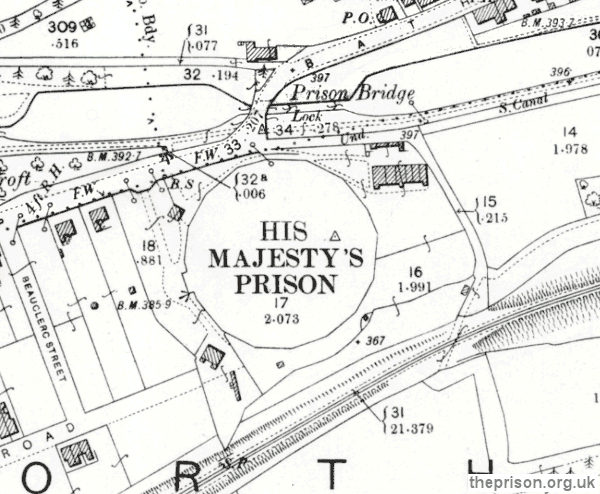
County Gaol site, Devizes, c.1899.
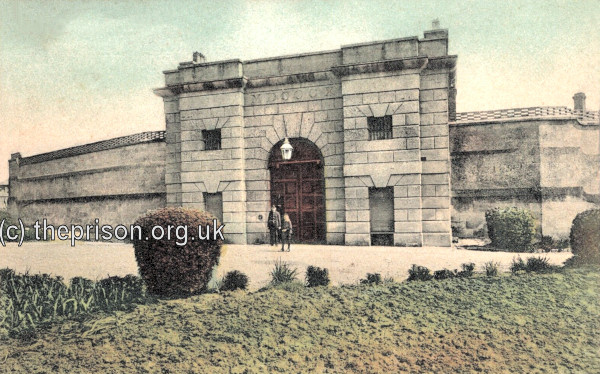
County Gaol, Devizes, early 1900s. © Peter Higginbotham
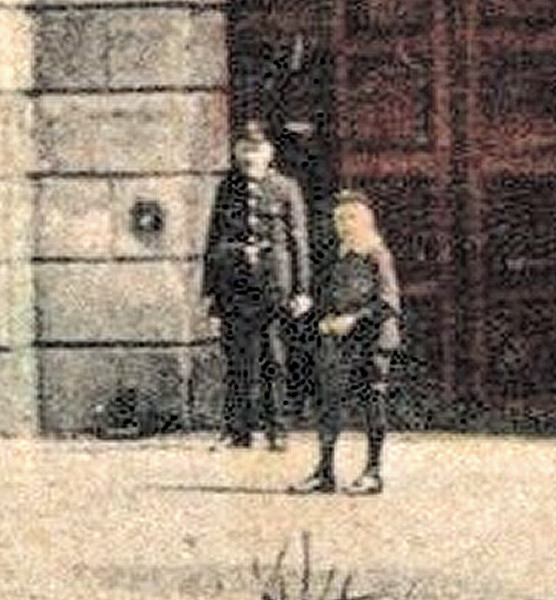
County Gaol, Devizes, early 1900s. © Peter Higginbotham
Following the nationalisation of the prison system in 1878, the site became HM Prison Devizes.
An survey of the prison in 1910 recorded:
Accommodation, 162 men and 29 women, total 191.
Daily average, 82 and 4 respectively; total 86.
Area of estate, 4.44 acres, of which is enclosed 1.96 acres.
Number of prisoners per acre accordingly, 43 and 97.
Devizes Prison stands on a beautiful site, which slopes to the south, on the south side of the main road to Bath, at the west end of the town and fifteen minutes walk from the Rail way Station.
It was built in 1810 and designed in a crescent form, never seen elsewhere, within a circular stone boundary wall like Dartmoor, enclosing a space about 110 yards in diameter.
The entrance gate faces west and the round Governor's house, with flat roof, occupies the centre of the circle.
The only buildings outside the boundary wall now in use are eight warders' quarters in two tenement blocks of four each, situated to the east of the prison. These are built of brick by the Commissioners,two flats high, and form, the only modern portion of this curious establishment.
The crescent form is really made up by eleven straight lengths, the middle one of which forms the men's prison centre. In the central court-yard around Governor's house there were once eleven radiating yards divided by walls and railings, but these are now reduced to six, three large yards of four or two spaces, and three small yards each of one space. Outside the crescent building is a 30ft. wide ring-space between the prison block, and the circular boundary wall, but the chapel, behind the male centre, stands in this ring and approaches at north corner to within 8 ft. 8 in. of the outside wall!
The Gate-house is a curious vaulted building with a narrow cart-passage, a mess-room for warders on right and a gate-keeper's day and night room, divided by curtain on the left; no w-c. is here provided.
Round on the right, on entering the yard, are found the Clerk's and Governor's offices, in a one-flat building near the outer wall. Next is the general visiting room (old style) for one only, the females' reception,and the laundry, (entered from the females' side) and the outer yard, only ten feet wide here, is paved and used for clothes-drying. The detached kitchen stands in front of laundry.
On the left of the gate-house is the works' workshop with smiths', carpenters' and paint shop, and glass office for artisan-warder, but no prisoners were at work here when visited. Behind this a full-size weigh-bridge by Pooley with house for steelyard stands in the open; while beyond the works' workshop is found the industrial workshop, formerly treadwheel house, with glass front, connected by a wooden covered way or shelter with the left wing of the crescent building, which has doors at each “horn.” Between the gate-house and the Governor's house is a really nice flower garden.
Of the 11 sections of the crescent prison, nine are occupied by men (A and B) and two on the right or south, by women (C). The three sections on each side nearest the horns are two flats high, and the five central parts (all men's) are of three flats, but the top flat is above a closed arched and vaulted passage or corridor, and thus quite hidden from view inside.
Around the circular Governor's house or tower is a ring yard, 25 ft. wide, separating it from the inner yards before named. The to flat of Governor's house is used for stores (with separate staircase) and one room on middle flat is taken for Visiting Committee's office.
The four-space inner yard before named is assigned for men's exercise, is cultivated and has a disused pump-house in centre, one two spaced yard is for women's exercise, and one belongs to males' reception, and one other yard is used for wood-chopping, having a w-c. attached.
This prison has one of those curious walls of stone, about 18 ft. high, with two intakes and surmounted by an 18" high battlement of loose stones, supposed to fall when grasped! This plan extends all round the prison enclosure and is even applied to the yard division-wall also.
The Stone-yard is found in the outer ring: space, behind the left horn (or A) and needed both paving and a yard w-c. in 1903; these wants have been since supplied, and the boxes rebuilt in 1908. Beyond it, the special cell fitted in 1902 also extends into the ring space as an annex from back of A. The extract-flues from this cell were found to be connected with those on A II after its construction and therefore imperfect till separated.
In 1903, the facilities for scaling the chapel roof externally caused some anxiety, but the rain-water pipes have since been blocked behind, and the stone slab roof sloping down over door from prison to chapel made less ladder-like.
Passing from behind the chapel around the ring-space, the Execution pit is seen; an old fashioned sunk arrangement, over which a new beam of the usual high type was fitted when required in the open. It is behind the males' reception, and was enclosed above ground in 1908.
The old dark cell for women also forms an annex from behind B and a new w-c. also for men, while the females' hospital is also “built out” into this space, which westwards is then crossed by a fence dividing males and females' yards.
The Drains have three exits from the prison yard; two of these are on the east side, each by 6" pipe. All the north side of yard is drained to an inspection pit just north of chapel, and the new w c. annex to B to the second pit some yards south of chapel, while the centre and west-side branch goes out behind the new females' hospital. These three drains all fall outside the boundary wall into a pipe drain starting from the warders' quarters and passing around outside the south wall to a disconnecting manhole at south-west corner of property, whence they join the 24" diameter town brick sewer.
The Gas supply is by a 2½" pipe entering through the gate-house, where there is a 150-light meter. The supply to warders' quarters was also drawn from this source, but a direct connection has now been made.
A 3" Water pipe from the town enters the yard at north-west side, and there is a ground meter outside, near the old disused mill, demolished in 1908. There are two fire hydrants in the centre yard.
Entering the males’ corridor 8' 2" wide on north side by the door from the males' exercise yard, it was found that all the heating pipes were in 1903 below the corridor or passage floor, with open gratings over, but in 1904 the “flows” were brought up into the corridor itself, from which the heat enters the cells by holes above the doors. The extraction gratings are below, near the floor, in corridor wall, forming entrances into flues passing up these and led to two vertical shafts, one placed at each outer end of the three-flat portion of the crescent prison. There are not in every case separate flues from each cell, some entering the same flue as the extract from cell below.
Passing to the prison centre on flat I there is seen the Chief Warder's office, a large vaulted room with a pillar supporting the floor over. The front door of the prison (but one of six) occupies the next space to south, and then comes the stoke-hole in which the old tubular built-in hot-water boilers were replaced by vertical cast iron boilers in 1904. Passing on south into B I wing, three men's weekly baths are seen, fed by a copper, and here is the new and vaulted padded cell on outer side, fitted in 1903 with canvas pads; it is a very large apartment. Next to it towards the centre is the men's matted cell. It was noted that all the cell floors, both upstairs and down, are of stone or bricks. Passing south again the Men's Reception section is entered, where are found two very old black cast iron baths (on the outside) and the examination room opposite has a glass front to corridor, and is heated by a good stove. Next on right to A is the clothes store, unheated, where damp was feared, then comes the reception entrance from the inner yard. It should be noted that the males' reception occupies the section of prison next to the females, and that it is only two flats high; over the examination room is a private clothes store. The males' reception has an internal staircase of its own, and here it may be noted that the stone stairs generally, in cell-spaces, from flat II to flat III are not always over those from flat I to flat II. The women's stair (I to II) is at junction of sections on inner side.
There are two reception cells below and six above, and the beds of some were laid on stone blocks 18" high and served as tables also, and this is repeated on flat III in another section.
Note that there are no gas-flues in this prison. Till 1908, 94 cells had naked internal lights, 97 had gas-boxes with tin shutter and slit over, with an iron rim frame for ¼" clear plate glass.
Going upstairs in males' prison, the lower galleries are found to be 12 ft. high, and there are three staircases all set back in cell-spaces without any possible supervision.
As a type of an ordinary cell B II 18 was examined. It was 7' 0" wide by 8' 0" deep and a semi-arch or barrel roof 10' 4" to crown. The window was 2' 5" × 2'4" high with a double wood sash of 12 panes of clear glass.
There were heavy vertical guard-bars of 1½" by 1½" iron placed diagonally in plan, and one cross-bar. The door was of three vertical planks outside, but in two thicknesses and crosswise inside; those in men's cells only being sheathed. They had large Hobbs' locks dated 1901 and vertical inspections 12" x 1" with wood flaps outside. Many of the windows on flats II and III had wooden hopper casings outside to prevent seeing abroad, the last ten were being fitted 4 November, 1903. As before noted, the corridor or passages are only 8' 2" wide, and the two galleries upstairs on flat II only 2' 1" apart; flat II was therefore very dark.
The Infirmary consists of two rooms on flat III over the men's prison centre, and some 8 or 10 cells on A II passage are used for the sick when so required.
The top flat is, as already indicated, quite different; its corridor is only 4' 9" wide, the inner corridor wall being carried on the groined and arched roof over flat II; the cells are 12 ft. deep on inside and 8 ft. deep on outside face by 7 ft. wide, and of the same height as below; the extract flues from inner cells below must be very crooked,and difficult to trace or to clean.
The inside of the Chapel, which stands north and south at back of males' centre, is 27 ft. wide, 15' 8" high to eaves and 22' 3½" to ridge, and the ceiling is on the under side of the rafters. There are three east side windows with semi-circular heads, two more on south, and one on north end. The men sit on the flat, in narrow curved seats facing north; the women in the gallery at south end, which they can only reach by passing through three sections of the males prison, including the males' reception. The altar and pulpit are at the north end and some structural improvements at this end were made from private funds in 1905. There are lights on the west side, but they only open into males' prison-centre corridor.
Entering the Women's Prison, it was found as indicated to occupy two lengths of the crescent and to be 9 cell-spaces long, on two flats only. Three female warders’ bedrooms have to be taken off this and one double association room, leaving 13 cells. A w-c. annex had already been provided by the builder, projecting into the inner ring.
To aid the heating, a gill stove had been placed in corridor in 1903; C II 11 was 54° and C II 14 was 56° on 4 November, 1903, and the corridor was warmer than the cells. Complaints were afterwards met by raising the circulation flow pipe above corridor floor, as was done in A and B. The women’s cells and corridor were similar to those described on flats I & II for the men, but had brick floors, and both cells and corridor were lighter and sunnier because of the absence of flat III. A new Female Hospital was built out at the back in 1902, and is a small well-fitted room for three beds.
The Female Reception is found between the general visiting room next Governor's office and the laundry; it has one cell only for dressing,and a reception bath. The weekly females; baths are on left on entering C wing.
The Laundry contained seven wash-tubs in three sets and a copper, but the drying-closet is of more interest. It was re-fitted in 1903 by Haden of Trowbridge on new views, and not on his system. There are seven horses with sheet-iron galvanized fronts and double wheel carriages, and the rods are all left open at the ends to admit fresh air: The steam from clothing is drawn to chimney by radiating flues and holes through the roof. The temperature was 154" when visited, but the back clothing was drier than the front. The tubes drew in well below, but those at top were dead. Great satisfaction was expressed by the warders, more especially as “outside” washing is done here! The horses' fronts were tight at foot, but clear 3/8" at top. The laundry was the most cheerful, bright place in the whole prison.
The Prison Kitchen, worked by men, is in middle yard to right front of Governor's house, as before noted. There were four coppers, two steamers, a stone washing-up trough, two steam boilers, for a daily average of 114, and one oven, in which two batches are baked nearly every day. The roof is louvred nearly all, along, and the place bright and clean. The Cook wanted no urinal other than the pail in use, nor a w-c? There is no bread store except 8,£and the range then needed repair.
The common disinfector for male and females adjoins the east wall of kitchen.
It seems never to have occurred to the Architect of Devizes Prison that a curved plan would be the worst possible for supervision, and the most expensive to construct. A prisoner has only to walk a few yards in any one of these corridors to get entirely out of sight of a warder following him; a centre of observation, as aimed at in radial prisons, is impossible; open stretches of wide straight corridor, with: length determined by the visual powers of the officers, even the old hollow square seen at Shepton Mallet, all these possible designs appear to have been set aside for a fad of an amateur, contrary to all clear thinking on prison management and economy.
The prison closed in 1914. The buildings no longer survive and housing now covers the site.
Records
Note: many repositories impose a closure period of up to 100 years for records identifying individuals. Before travelling a long distance, always check that the records you want to consult will be available.
- Wiltshire and Swindon Archives, Wiltshire and Swindon History Centre, Cocklebury Road, Chippenham SN15 3QN. Holdings include: Return of prisoners at Devizes, giving name, age, committal date, offence, sentence and behaviour (1822); Account book for maintenance of prisoners after sentence with details of conviction, and for costs of prosecutions (1841-1876, 1879-1889)); Lists of prisoners and reports of the Gaol Committee (1869-1877); Register of prisoners (1879-1881); Minister's register, giving prisoners' denominations (1873-1878).
- Gloucestershire Archives, Clarence Row, Alvin Street, Gloucester GL1 3DW. Has Devizes prisoners' property book, giving names and details of clothing and money owned (1865-1878).
- The National Archives, Kew, Richmond, Surrey, TW9 4DU. Has a wide variety of crime and prison records going back to the 1770s, including calendars of prisoners, prison registers and criminal registers.
- Find My Past has digitized many of the National Archives' prison records, including prisoner-of-war records, plus a variety of local records including Manchester, York and Plymouth. More information.
- Prison-related records on
Ancestry UK
include Prison Commission Records, 1770-1951
, and local records from London, Swansea, Gloucesterhire and West Yorkshire. More information.
- The Genealogist also has a number of National Archives' prison records. More information.
Census
Bibliography
- Higginbotham, Peter The Prison Cookbook: A History of the English Prison and its Food (2010, The History Press)
- Brodie, A. Behind Bars - The Hidden Architecture of England's Prisons (2000, English Heritage)
- Brodie, A., Croom, J. & Davies, J.O. English Prisons: An Architectural History (2002, English Heritage)
- Harding, C., Hines, B., Ireland, R., Rawlings, P. Imprisonment in England and Wales (1985, Croom Helm)
- McConville, Sean A History of English Prison Administration: Volume I 1750-1877 (1981, Routledge & Kegan Paul)
- Morris, N. and Rothman, D.G. (eds.) The Oxfod History of the Prison (1997, OUP)
- Pugh R.B. Imprisonment in Medieval England (1968, CUP)
Links
- Prison Oracle - resources those involved in present-day UK prisons.
- GOV.UK - UK Government's information on sentencing, probation and support for families.
Except where indicated, this page () © Peter Higginbotham. Contents may not be reproduced without permission.