

City Gaol, Salisbury, Wiltshire
A Town Gaol was operating in Salisbury by 1246. It was established by Richard Poore, the Bishop of Salisbury. By 1346, it was located in the Guildhall, erected in 1314 at the south-east corner of the Market Place by the then bishop, Simon of Ghent. The upkeep of the building remained the responsibility of the Bishops of Salisbury.
In 1784, John Howard wrote that the prison was:
The property of the bishop : out of repair. Two rooms for felons, and three above them for debtors. No court : no water : no straw. The late gaoler paid £8 a year to a domestic of the Bishop. His Lordship sends to the prisoners at Christmas 30 shillings worth of meat, and 10 shillings worth of bread. Keeper, a sheriff's officer. Licence for beer : Fees, 14s. 8d. no table. Allowance, debtors, none: felons, two pence a day. At my last visit, the lower rooms were let to the military for deserters &c. at 2s. A week.
| 1775, Dec. 27, | Debtors 3, | Felons &c. 2. | Deserters 0. |
| 1776, Sep. 3, | 2, | 0. | 2. |
| 1779, Feb. 28, | 1, | 1. | 0. |
| 1782, Feb. 27, | 1, | 0. | 1. |
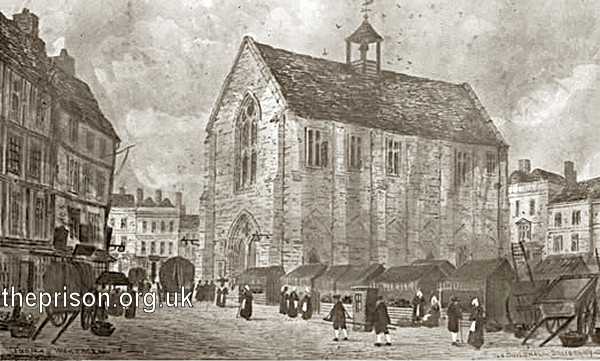
Bishop's Guildhall, Salisbury, Wiltshire.
By the late 18th century it was in a state of disrepair and, after an Act of Parliament in 1785 released the bishop from its upkeep, it was demolished in 1788 to make way for the new Guildhall, on the same site, completed in 1794. From this time, prisoners were housed in the county gaol at Fisherton Anger, which was formally redesignated as a joint county and city gaol in 1800.
Records
Note: many repositories impose a closure period of up to 100 years for records identifying individuals. Before travelling a long distance, always check that the records you want to consult will be available.
- Wiltshire and Swindon Archives, Wiltshire and Swindon History Centre, Cocklebury Road, Chippenham SN15 3QN.
- The National Archives, Kew, Richmond, Surrey, TW9 4DU. Has a wide variety of crime and prison records going back to the 1770s, including calendars of prisoners, prison registers and criminal registers.
- Find My Past has digitized many of the National Archives' prison records, including prisoner-of-war records, plus a variety of local records including Manchester, York and Plymouth. More information.
- Prison-related records on
Ancestry UK
include Prison Commission Records, 1770-1951
, and local records from London, Swansea, Gloucesterhire and West Yorkshire. More information.
- The Genealogist also has a number of National Archives' prison records. More information.
Bibliography
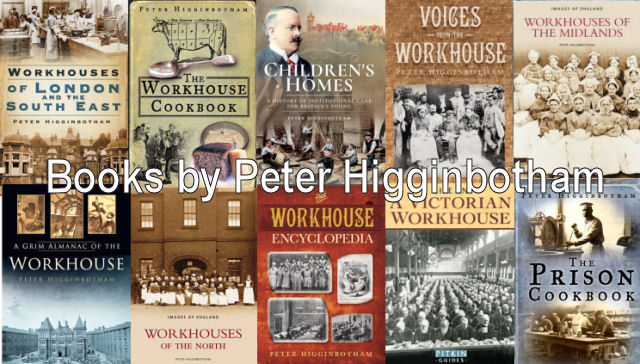
- Higginbotham, Peter The Prison Cookbook: A History of the English Prison and its Food (2010, The History Press)
- Brodie, A. Behind Bars - The Hidden Architecture of England's Prisons (2000, English Heritage)
- Brodie, A., Croom, J. & Davies, J.O. English Prisons: An Architectural History (2002, English Heritage)
- Harding, C., Hines, B., Ireland, R., Rawlings, P. Imprisonment in England and Wales (1985, Croom Helm)
- McConville, Sean A History of English Prison Administration: Volume I 1750-1877 (1981, Routledge & Kegan Paul)
- Morris, N. and Rothman, D.G. (eds.) The Oxfod History of the Prison (1997, OUP)
- Pugh R.B. Imprisonment in Medieval England (1968, CUP)
Links
- Prison Oracle - resources those involved in present-day UK prisons.
- GOV.UK - UK Government's information on sentencing, probation and support for families.
Except where indicated, this page () © Peter Higginbotham. Contents may not be reproduced without permission.